The Story of The Organ Club
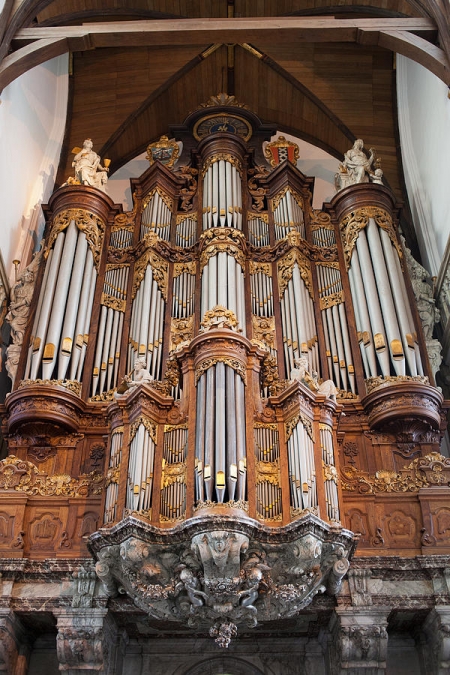
Do you remember the first time you saw the enormous pipes of a gigantic pipe-organ? Did you marvel at its strange and wonderful noises: from the roars of a wild animal to the sweetest, quietest melodies of a tiny flute rank? Were you then shocked to realise that this whole sound-world was being controlled by one small human being sitting on a bench?
The composer Mozart called the organ “The King of Instruments”.

One hundred years ago, in 1926, a group of fourteen organ enthusiasts gathered at St John’s Wood Presbyterian Church in London. A month later, forty-four people appeared for a more formal meeting in the Liberal Jewish Synagogue in St John’s Wood.
A well-known organ builder, Henry Willis III, was elected president, and an annual subscription of five shillings was agreed.
Once a month, the new members of The Organ Club visited organs in churches, cathedrals, synagogues, cinemas, town halls and even private houses - beginning with the newly-restored instrument in St Michael’s Cornhill, in the City of London, where the director of music, Harold Darke, demonstrated the organ’s varied tone-colours in a special recital.
There have been visits to organ builders’ workshops, and regular overseas visits: frequently to mainland Europe, as well as to the USA and Australia. One of the most exciting tours was an exploration of the churches in which Bach worked: in an area of Germany which, in the early 1980s, was still in the secretive German Democratic Republic.

Many leading organists have shared with us their talents and passion for organ music. Vice-Presidents have included Ralph Downes, Susi Jeans, Dame Gillian Weir,
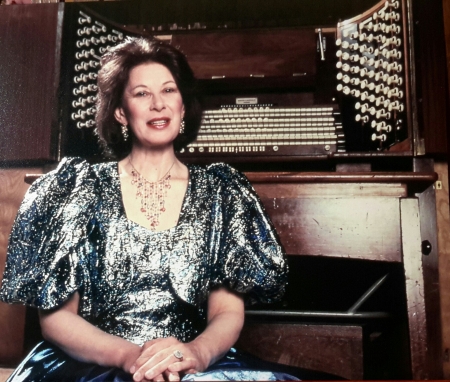
Dame Gillian Weir in the Royal Festival Hall, London
Sir Stephen Cleobury, Anne Marsden Thomas, John Scott, James Parsons and Sir William McKie. At annual lunches, we have been addressed by a former Prime Minister Sir Edward Heath, by the Bishop of London, by the composer Herbert Howells, and by the renowned organists Sir George Thalben-Ball and Simon Preston. For our fifty-year celebrations, the Club's patron was The Duchess of Kent.
For special anniversaries, the Club has commissioned composers to write new organ pieces: Sir Lennox Berkeley (Fantasia), Kenneth Leighton (Paean for solo organ, and Martyrs for duet), Peter Hurford (Toccatina), Noel Tredinnick (Brief Encounters) and Michael Berkeley (Wild Bells).
Now, in the twenty-first century, we know that many children have never entered a church, or heard live classical music. The Club is supporting the efforts of the campaign (known as Play the Organ Year), in an effort to introduce new generations to the wonders of the organ. The Club organises an annual organ-playing competition and masterclasses for teenagers. Special activities are arranged by a student-group calling itself The Musketeers!
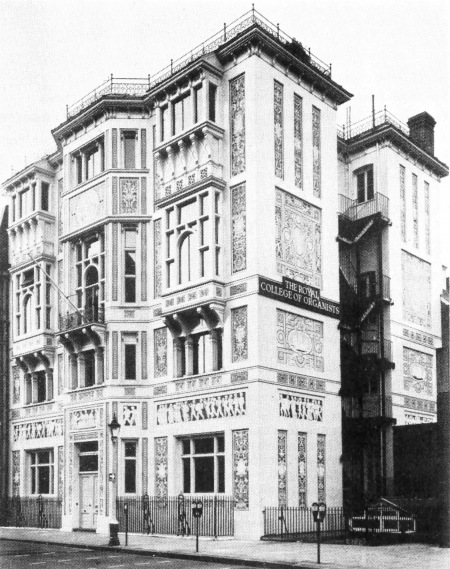
For many years, we held our AGM Recital in the organ hall of the Royal College of Organists, across the road from the Royal Albert Hall; and our 750-volume library was housed in the RCO, in vast Victorian glass-fronted cabinets (it has now been moved to the Royal Academy of Music).
We are always happy to work with other organisations. For the International Congress of Organists in 1987, the Club joined the RCO, the Royal School of Church Music, the Incorporated Association of Organists, the Incorporated Society of Musicians and the British Institute of Organ Studies, to welcome the many hundreds of visitors from overseas.
Our presidents normally serve a two-year term. Most of them play the organ in a local church, though some have been professional recitalists. The others represent a wide range of professions: school teachers, a dentist, a patent agent, engineers, a civil servant, a submarine commander and a nuclear scientist.
At its peak in the 1970s and 1980s, the Club’s membership hovered just under 900. It dipped during the covid lockdowns. We have an exciting programme of events, so do join, if you are not at present a member!